Do you love cinnamon rolls, but the gluten in cinnamon rolls doesn’t love you back? Are you not a fan of waiting for the yeast to work?
This recipe can hit the spot by delivering the fresh-baked goodness of cinnamon rolls without the gluten or yeast.
Table of Contents
These cinnamon rolls are soft, fluffy, and ready the same day, without the stress of proofing or complicated flour blends.
If you’ve ever pulled dense, gummy gluten-free rolls out of the oven, this recipe changes everything.
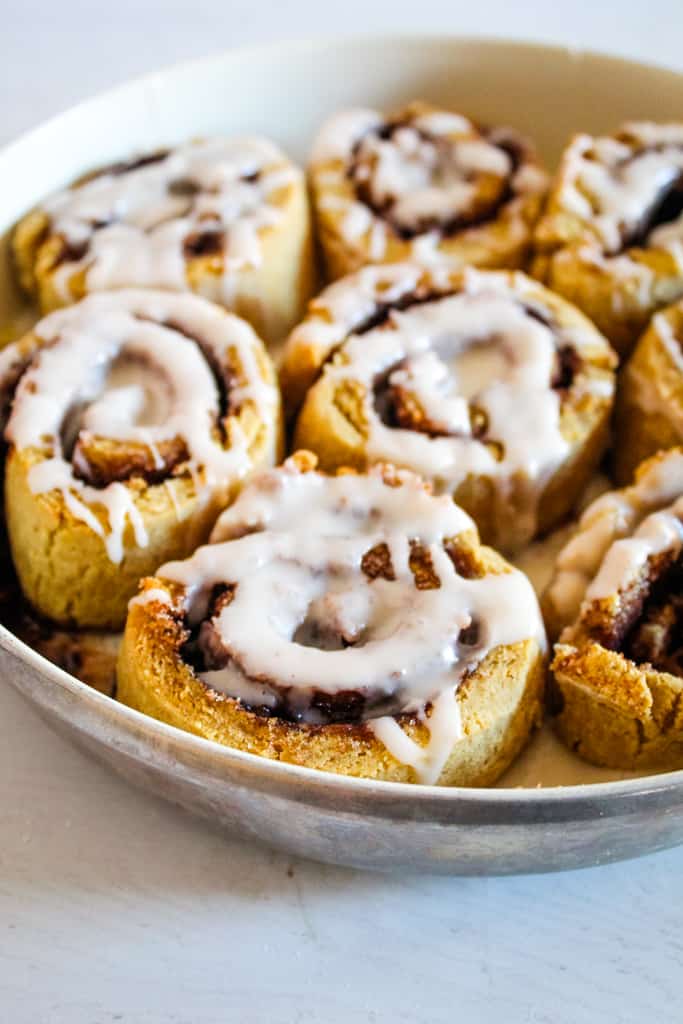
Why This Recipe Is The Best!
I love cinnamon rolls with yeast when I have time to make them. There’s just a fluffy goodness that comes with having time to let the dough rise.
Sometimes, though, I just don’t have that kind of time. That makes an easy-to-prepare recipe like this one a good alternative when I don’t have hours to let the dough rise. (I know, I could let it rise while I’m doing other things, but leaving the kitchen when I’m in the middle of making something always makes me nervous!)
That makes a yeast-free recipe like this ideal when I want cinnamon rolls. Even better for people on a gluten-free diet, this recipe uses a gluten-free flour mix and potato flakes.
(I’ll be honest, I’m a fan of making my own gluten-free flour. King Arthur Gluten-Free Measure-for-Measure Flour might work in a pinch, but you may have to adjust the amounts of the other ingredients to keep the cinnamon rolls from getting too dense.)
Equipment for Gluten-Free, Yeast-Free Cinnamon Rolls
You’ll probably already have most of these in your kitchen! The one I actually had to go out and find a while ago is the digital scale, and now it’s one of the things I use most when I’m making gluten-free recipes like this one. (You’d be surprised by how finicky gluten-free baked goods can be about getting exactly the right amounts. Just a tablespoon too much or too little of something like flour can really throw off the density of the finished item.)
- Digital scale
- Large bowl
- Medium bowl
- Whisk
- Rubber spatula
- Wax paper
- Rolling pin
- Baking pan
- Newly opened pack of unflavored dental floss (because you don’t want to risk it being gross).
Ingredients for Gluten-Free Cinnamon Rolls
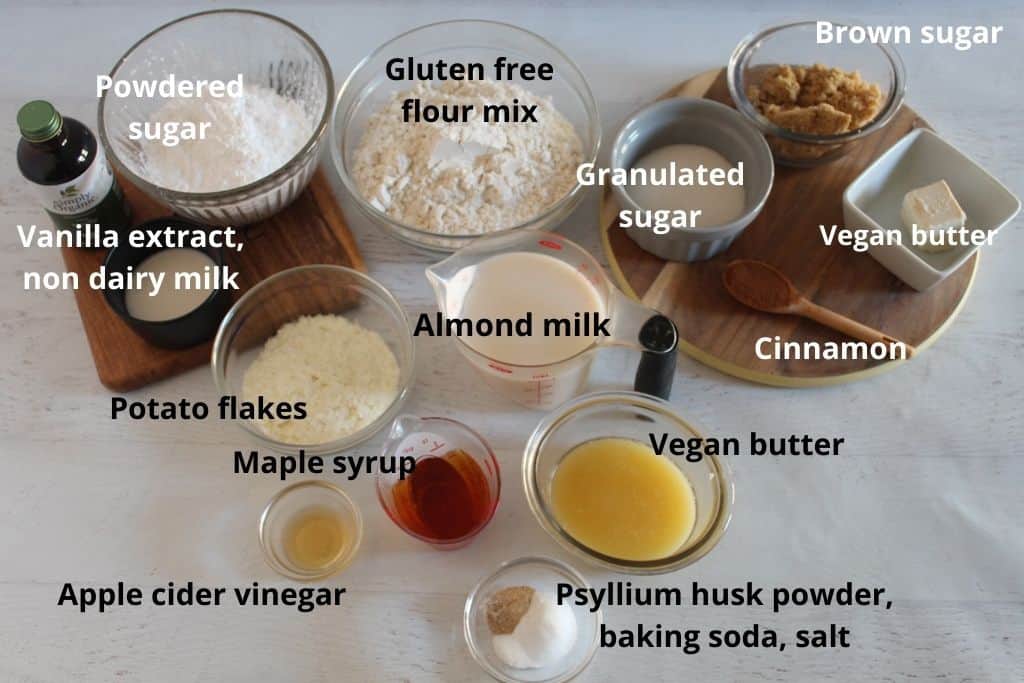
For convenience, I separated the ingredients into Rolls, Filling, and Icing. It’s still a long list, but that might make it more manageable.
Dough Ingredients
- Gluten-Free Flour Mix
- Potato Flakes
- Baking Soda
- Psyllium Husk Powder
- Salt
- Pure Maple Flour
- Vegan Butter
- Almond Milk
- Apple Cider Vinegar
Cinnamon Filling Ingredients
- Brown sugar
- Granulated sugar
- Vegan butter
- Cinnamon
Icing Ingredients
- Powdered sugar
- Vanilla extract
- Almond milk
Ingredient Roles & Functions
Why these ingredients? Each of them adds something to these cinnamon rolls that gives them their excellent flavor and texture.
Gluten-Free Flour Mix
355 grams gluten-free flour mix (about 2 cups)
This mix of white rice flour, brown rice flour, potato flour, tapioca, and cornstarch provides the best balance of starches, proteins, and fiber to replace the gluten in all-purpose flour. When combined with the other ingredients in the rolls, it can do the job of trapping air and supporting the rolls’ structure.
Potato Flakes
30 grams of potato flakes (about 1/3 of a cup)
Potato flakes can help baked goods retain moisture and tenderness. This can help cinnamon rolls stay soft and fresh longer. Unlike potato flour, which is made by cooking, drying, and grinding whole potatoes, potato flakes are made by simply cooking and dehydrating the potatoes. Due to the differences in processing, potato flour tends to be denser than potato flakes.
Baking Soda
1 teaspoon baking soda
Baking soda makes a good leavening agent in the absence of yeast.
Psyllium Husk Powder
1/2 teaspoon psyllium husk powder
Psyllium husk powder makes a good binder in the absence of gluten and other binders like eggs. It is also quite good at absorbing moisture, which helps keep these rolls moist and fresh.
Salt
1/4 teaspoon salt
Like many baked goods, cinnamon rolls don’t need much salt and usually don’t taste salty. The salt is mostly there to help regulate the leavening agents’ activity and support many of the chemical reactions that contribute to the cinnamon rolls’ flavor.
Maple Syrup
3 Tablespoons Maple Syrup
As you might guess, maple syrup adds a little of the necessary liquid and a lot of the sweetness to the rolls.
Vegan Butter
4 tablespoons vegan butter
The melted vegan butter adds some of the creamy richness to the cinnamon rolls and filling.
Tip when using vegan butter: Just like dairy butter, you want to make sure it doesn’t have an odd odor or unusual texture before using.
Almond Milk
1 cup almond milk
This adds the bulk of the liquid and creaminess to the cinnamon rolls. It also adds the slightest nutty flavor and works with the leavening agents to support the rolls’ texture.
Buying almond milk at the store? Checking the expiration date is good, but inspecting the carton’s shape is better for making sure it hasn’t gone bad. If the carton is bloated, the almond milk may have gone bad. Other ways to tell whether almond milk has gone bad include a bad odor when you open and sniff it, a slimy or curdled texture, or a change in color from when it was fresh.
Apple Cider Vinegar
1 tablespoon apple cider vinegar
Apple cider vinegar has a milder flavor than white vinegar and provides the acid that baking soda needs to react with to work as a leavening agent.
Brown Sugar and Granulated Sugar
55 grams brown sugar (about 1/4 cup)
50 grams granulated sugar (about 1/4 cup)
This is where you’ll really need your digital scale, since each of these amounts is estimated at about 1/4 cup, but isn’t exactly. Each of these adds sweetness to the filling, with the brown sugar adding a more robust flavor due to its molasses content. (I like to get the dark brown sugar when I want extra molasses for the flavor.)
Cinnamon
1 teaspoon cinnamon
Of course, you can experiment with the amount of cinnamon in case you like your cinnamon rolls with extra cinnamon flavor. This is why they’re called cinnamon rolls!
Powdered Sugar
112 grams powdered sugar (about 1 cup)
Powdered sugar is also known as confectioners’ sugar because it’s a favorite for making icings for sweet baked goods like cinnamon rolls. It dissolves easily for a smooth texture without needing to be cooked.
Vanilla Extract
1/2 teaspoon vanilla extract
Vanilla extract typically adds a robust flavor to sweet foods like cinnamon rolls.
Printable Gluten-Free, No-Yeast Cinnamon Rolls Recipe Card
Ingredients
For the cinnamon rolls
- 355 grams gluten free flour mix about 2 3/4 cup
- 30 grams potato flakes about 1/3 a cup
- 2 teaspoons baking soda
- 1/2 teaspoon psyllium husk powder
- 1/4 teaspoon salt
- 3 Tablespoons pure maple syrup
- 4 Tablespoons non dairy butter melted
- 1 cup almond milk
- 1 teaspoon apple cider vinegar
For the filling
- 55 grams brown sugar about 1/4 cup
- 50 grams granulated sugar about 1/4 cup
- 1 teaspoon cinnamon
- 2 Tablespoons vegan butter softened
For the icing
- 112 grams powdered sugar about 1 cup
- 1/2 teaspoon vanilla extract
- 3 Tablespoon almond milk
Instructions
For dough:
- In a medium bowl, mix together the flour mix, potato flakes, baking soda, psyllium husk powder and salt.
- In a large bowl, whisk together the maple syrup, vegan butter, almond milk and vinegar.
- Using a sturdy spoon, slowly stir the dry ingredients into the wet. Dough will come together.
- Sprinkle a surface or a sheet of wax paper with a sprinkling of gluten free flour mix. Place dough on the surface and roll into a 10.5" x 14" rectangle, about 1/4" thick.
For filling:
- In a small bowl, mix the brown sugar, white sugar and cinnamon together.
For assembly:
- Spread the 2 Tablespoons of softened butter over the rolled dough.
- Sprinkle the sugar-cinnamon filling mixture all over the butter.
- Once completely covered, start at the short end of the dough and roll up, into a log, keeping the log as tight as possible.
- Score the log with a knife, making 8 rolls.
- Using a piece of unflavored dental floss, slide the floss under each score mark and use the floss to slice through each roll.
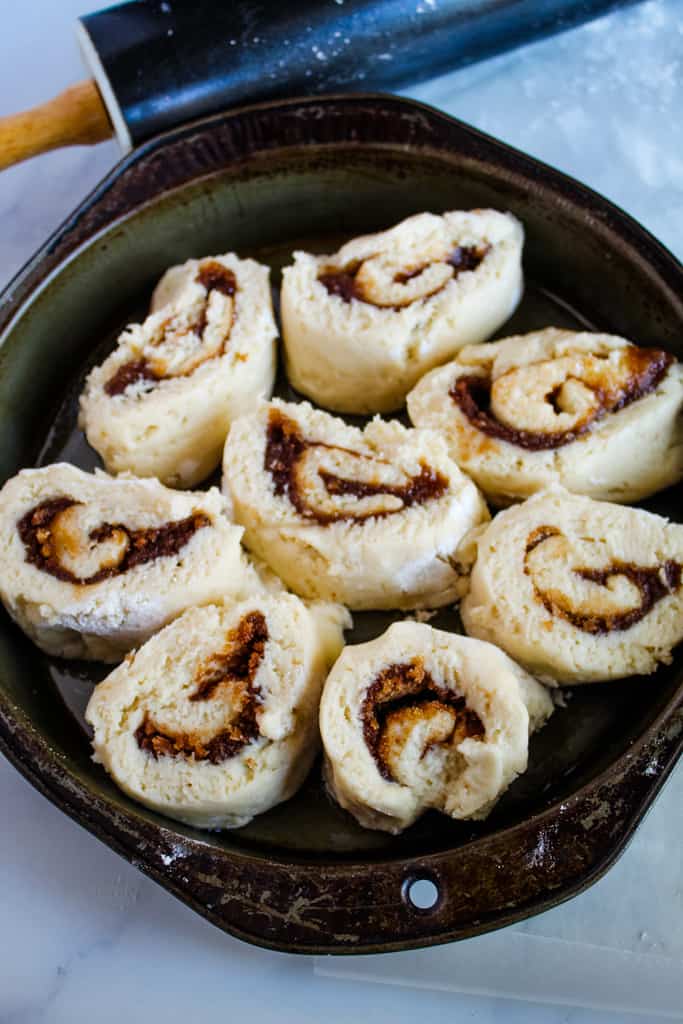
- Spray an 8" round baking pan with cooking spray. Place each roll in the pan, cut side up.
- Cover the baking pan with a towel an allow the rolls to rest for 30 minutes.
- Toward the end of the rest time, preheat the oven to 350 F.
- Bake the rolls for 30-35 minutes. Let cool for a few minutes then top with icing.
For icing:
- In a small bowl, combine powdered sugar, vanilla and milk. Stir until smooth and lump free.
Nutrition
Method for Making Gluten-Free, Yeast-Free Cinnamon Rolls
Making gluten-free, yeast-free cinnamon rolls can be easier than you think. So, how about we jump right into it?
Step One: Bring All Ingredients Up to Room Temperature
It’s okay if you don’t get started on them right away. If you’re busy with other things, leave the ingredients on the counter for a bit while you finish up whatever you’re doing. That way, they can come up to room temperature, and you won’t get distracted. Just don’t forget, for food safety reasons!
Step Two: Mix Dry Ingredients for Dough
In a medium bowl, mix together the flour mix, potato flakes, baking soda, psyllium husk powder, and salt until evenly mixed.
Step Three: Mix Wet Ingredients for Dough in a Separate Bowl
Whisk together the maple syrup, vegan butter, almond milk, and vinegar in a large bowl.
Step Four: Mix Dry Ingredients Into Wet Ingredients
Gradually add the dry ingredients to the large bowl of wet ingredients, stirring with a sturdy spoon until the dry ingredients are completely mixed in.
Step Four: Transfer Dough to Work Surface
Sprinkle a surface or a sheet of wax paper with a sprinkling of gluten-free flour mix. Place dough on the surface and roll into a 10.5″ x 14″ rectangle, about 1/4″ thick.
Step Five: Make Filling
In a small bowl, mix the brown sugar, white sugar, and cinnamon together until evenly combined.
Step Six: Assemble Rolls
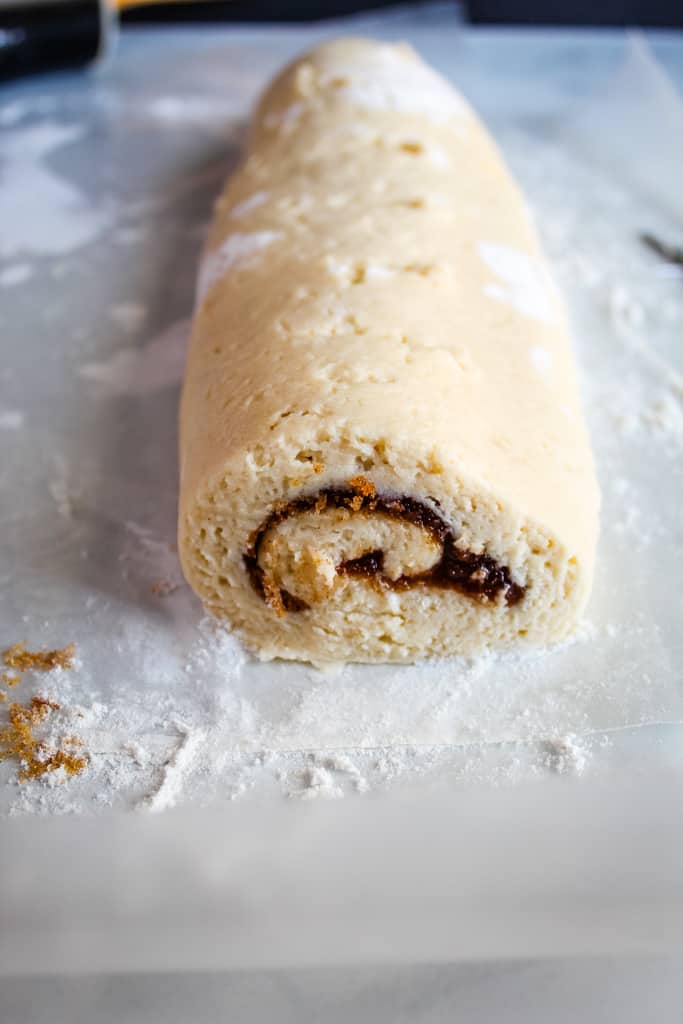
This is a somewhat tricky but important part, so be patient with it! Spread two tablespoons of softened butter evenly over the dough. Then sprinkle the cinnamon-sugar mixture evenly over the butter.
Once completely covered, start at the short end of the dough and roll up into a log, keeping the log as tight as possible. Go slowly with this, because you want to keep the edges even with each other while rolling it.
Score the log with a knife, making 8 rolls. Then open the brand-new unflavored roll of dental floss, get a long new piece, and slide the floss under each score mark. Use the floss to slice through each roll. When done, discard the piece of floss.
Step Seven: Arrange Rolls on Baking Sheet
Spray an 8″ round baking pan with cooking spray. Place each roll in the pan, cut side up.
Step Eight: Allow Rolls to Rest
Cover rolls with a towel and allow to rest for 30 minutes. This allows the ingredients to start combining and building the rolls’ structure.
Step Nine: Preheat Oven
While rolls are resting, preheat the oven to 350 degrees Fahrenheit (175 Celsius).
Step Ten: Bake Rolls
Bake the rolls for 30-35 minutes. Let cool.
Step Eleven: Make Icing While Rolls Are Baking
This is an easy step, but I like to have the icing ready to go when the rolls are. In a small bowl, combine powdered sugar, vanilla, and milk. Stir until smooth and lump-free.
Step Twelve: Put Icing on Cinnamon Rolls
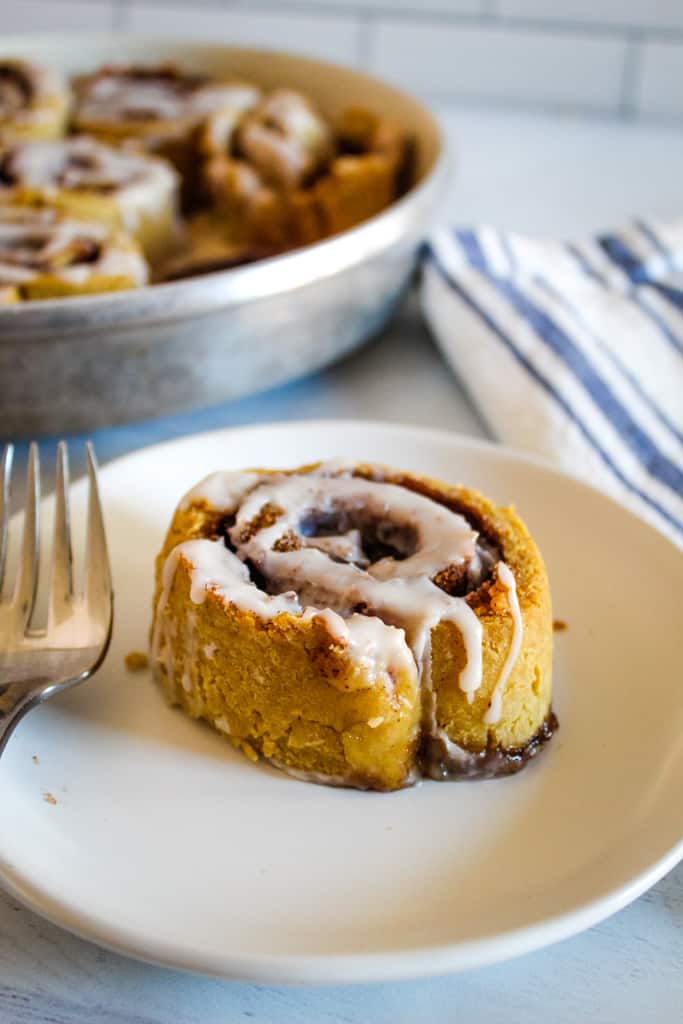
Did one or two cinnamon rolls go missing while you were waiting for them to cool enough to put the icing on? That doesn’t surprise me. I like them best when they’re fresh out of the oven, too! Just spread icing as evenly as possible on the tops of the remaining cinnamon rolls.
Nutrition Information for This Gluten-Free Cinnamon Roll Recipe
The nutrition information for this recipe is approximate and based on the recipe as shown. If you would like to explore the nutrition information of individual ingredients, please visit the USDA’s FoodData Central database.
- Calories: 382
- Total Fat: 12.2 grams
- Saturated Fat: 10.8 grams
- Cholesterol: 0 grams
- Sodium: 8,072 milligrams
- Total Carbohydrates: 68.9 grams
- Dietary Fiber: 8 grams
- Total Sugars: 51.9 grams
- Protein: 2 grams
Substitutions and Variations for Cinnamon Rolls
Sometimes I like to dice about 1/4 cup of fresh apple into small pieces and sprinkle it evenly over the dough before I roll it up.
You might have some luck buying some certified gluten-free flour at the grocery store. Just keep in mind that every flour behaves differently, so you may have to experiment a bit and adjust amounts of the other ingredients to suit before you find one that won’t make your rolls too dense. For the best results, look for a gluten-free flour that contains white rice flour, brown rice flour, tapioca, cornstarch, and potato flour.
The dairy-free butter and almond milk can be replaced with dairy butter and milk if you absolutely have to. (Honestly? I mostly like the dairy-free option for sharing with my friends who have a lactose intolerance and say they’ve missed cinnamon rolls!)
FAQs About Gluten-Free Cinnamon Rolls
These cinnamon rolls tend to be fairly straightforward to make. However, we do sometimes get questions. These are some of the most common questions (with answers). If you think of something we overlooked, feel free to let us know in the comments, and we’ll do our best to answer.
Can the cinnamon rolls be made in advance?
The dough can be mixed up in advance and kept in the fridge for a day or two before you need it. Bring the dough up to room temperature before you work with or bake it.
Can leftover cinnamon rolls be kept in the fridge?
I’ll be honest, I rarely make these unless I intend to share or eat them within a day or two. However, they can be kept in the fridge for 2-3 days.
Any longer than that and you may have to freeze them. They can be kept in the freezer for a few weeks. Thaw them out in the fridge overnight.
Will gluten-free cinnamon rolls without yeast still be fluffy?
This cinnamon roll recipe uses baking powder, which allows the rolls to turn out light and fluffy with only a half-hour rest time. The trick is that the baking powder does most of its work while it’s being baked.
Why are my gluten-free cinnamon rolls dense or gummy?
Cinnamon rolls might turn out dense or gummy if they are overmixed, contain too much flour, are underbaked, or don’t have enough leavening to add air to the mix. Sometimes dough that feels “too dry” can be livened up by sprinkling about a teaspoon of water over it while working with it.
How easy is it to double this recipe?
Fortunately pretty easy! You may just want to use two baking sheets instead of just one to avoid overcrowding the rolls while baking.
More Breakfast Recipes You May Like
Want some more to go with your breakfast, or are you looking for some ideas for meal prep? These recipes might go well with your cinnamon rolls!
- The Best Gluten-Free Breakfast Sandwich With Egg and Cheese
- Easy Gluten-Free Pumpkin Waffles (Dairy Free)
- Spiced Gluten-Free Pumpkin Donuts
- Easy & Delicious Gluten-Free Bread Pudding Recipe
- Cassava Flour Pancakes: Gluten-Free
Whether you’re planning a full brunch spread or stocking the freezer for busy mornings, these recipes make gluten-free breakfast feel anything but limiting.
Have Thoughts or Questions?
Did you try these cinnamon rolls? Did you like them, or do you have some feedback? Feel free to let us know in the comments!