Gluten-free bruschetta shouldn’t require compromise.
Too often, gluten-free bread turns out gummy in the center, crumbly at the edges, or too fragile to hold toppings. This recipe solves that. With the right balance of gluten-free flour, psyllium husk, and proper yeast activation, you’ll get a baguette that’s structured, sliceable, and crisp when toasted to form the perfect base of your bruschetta.
Table of Contents
Topped with a fresh olive and tomato tapenade, this version delivers bold Mediterranean flavor with none of the texture issues that frustrate gluten-free baking.
If you’ve been searching for a gluten-free bruschetta that actually holds together and tastes bakery-quality, this is it.
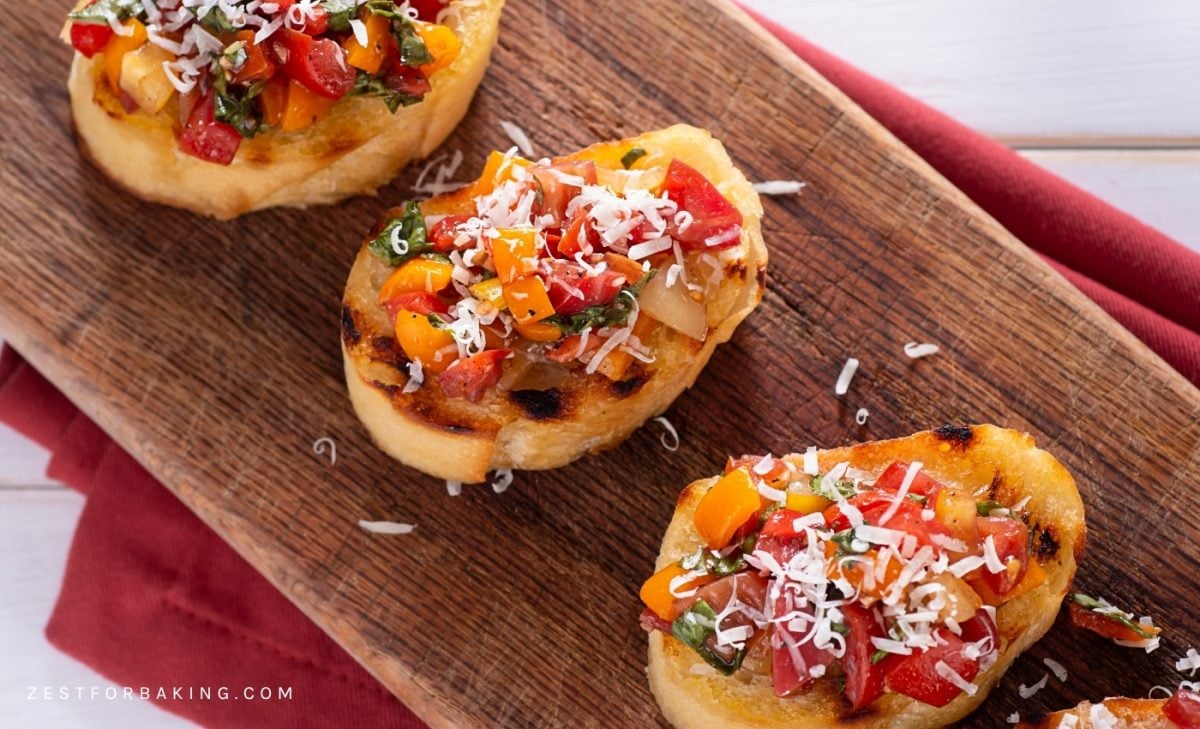
Ingredients for Gluten-Free Bruschetta
Before I start with a recipe like this, I like to make sure I have everything! Here’s a list of the ingredients we’ll need. If you need to make a quick grocery run first, don’t forget to print or save the recipe card below for easy reference.
For the Gluten-Free French Bread
- Gluten-free flour blend
- Psyllium husk powder
- Active dry yeast
- Sugar
- Salt
- Warm water (105–110°F / 40–43°C)
- Olive oil
For the Bruschetta Topping
The bruschetta topping can be customized to your liking. I usually like to go with this easy one for entertaining, though.
- Roma tomatoes
- Yellow tomatoes
- Green olives (or black olives if you prefer)
- Olive oil
- Garlic cloves
- Balsamic vinegar
- Fresh basil leaves
- Salt and pepper
- Lemon slices (to squeeze)
- Crushed chili flakes (optional)
- Vegan Parmesan cheese (optional)
Key Ingredient Roles
Why these ingredients? Let’s take a closer look at what each of these brings to this recipe!
Want our human-written content to rank above AI-generated garbage? Help us out by clicking this button!
Gluten-Free Flour
3 cups gluten-free flour
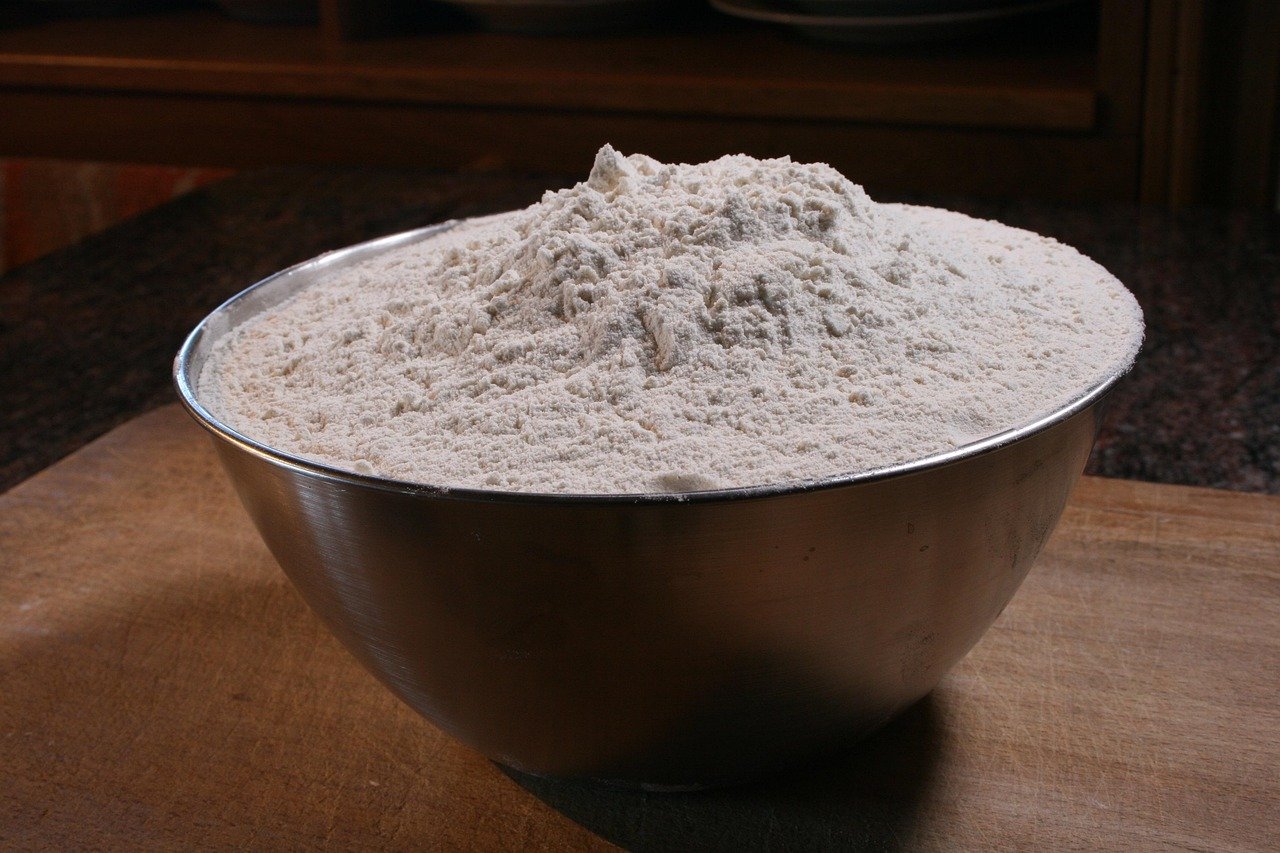
Whenever I make bread, I prefer to make my own gluten-free bread flour using this recipe for gluten-free bread flour that doesn’t include any Xanthan gum. If you decide to buy gluten-free bread flour, look for a blend that includes potato flour, tapioca, cornstarch, white rice flour, and brown rice flour. That’ll give you the mix you need to get started with making gluten-free bread with exactly the right texture.
Psyllium Husk Powder
2 tbsp psyllium husk powder
Psyllium husk powder can help support the shape and texture of bread as it bakes. While it is more often used in “spongy” baked goods like tortillas and flatbreads, its fiber content makes it very good at absorbing moisture and adding volume when exposed to liquids.
Its ability to retain moisture is something to watch out for when baking with psyllium husk powder, by the way. If you add too much, it’ll absorb all the liquid!
Dry Yeast
2 tbsp dry yeast
Dry yeast provides a lot of the “rising power” in the dough for most breads. Yeast is a biological leavening agent that metabolizes sugar to produce the CO2 that makes bread dough rise.
Sugar
1-2 tsp sugar
The sugar is mostly there to give yeast something to work with, as it adds the CO2 that creates just the right texture for the French bread.
Salt
1 1/2 tsp salt
Salt actually helps regulate the yeast to keep it from working too fast. It also helps with flavor without overdoing it with the saltiness (as long as you don’t accidentally add too much). Normally, it would help support the gluten in baked goods. It just doesn’t do that in this bruschetta because it’s gluten-free.
Warm Water
1 1/2 cups warm water
The trick here is to get the water warm without it being too warm! You want to aim for about 105 to 110 degrees Fahrenheit (about 40.5 to 43.3 degrees Celsius) to optimize it for activating the yeast. Too cold, and the yeast won’t activate properly. If you get it much above 120 degrees, you risk killing the yeast.
Olive Oil
2 tbsp olive oil for bread
4 tbsp olive oil for topping mix
Olive oil is typically used as a heart-healthy alternative to butter or other oils to provide necessary fat and moisture for the bread. It forms the liquid base for the topping mix.
Roma Tomatoes and Yellow Tomatoes
2 cups of chopped Roma tomatoes
1/2 cup of chopped yellow tomatoes
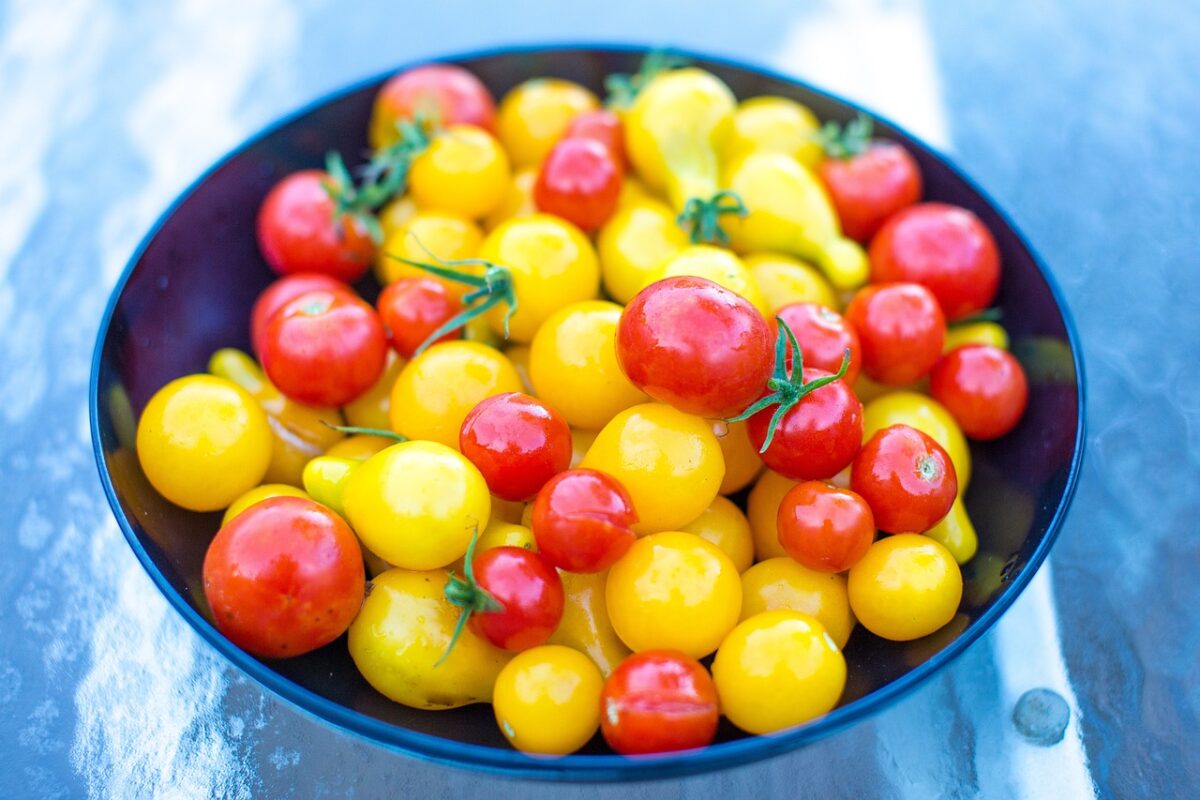
The red of Roma tomatoes and the yellow tomatoes add some nice color to the bruschetta topping. I like to find tomatoes that have a bold flavor for bruschetta.
Olives
1/2 cup green or black olives
A lot of bruschetta recipes call for green olives, but I could go either green or black, depending on what I have on hand. Besides the olive flavor, it adds more variety of color to the topping.
Garlic Cloves
5 garlic cloves
Seems like a lot of garlic? Believe me, you’ll need it if you have guests who have complained that bruschetta is boring in the past! I like a good dash of flavor in bruschetta, too.
Balsamic Vinegar
1 tablespoon balsamic vinegar
The balsamic vinegar provides a light acidic flavor that complements the tomatoes, garlic, and basil.
Fresh Basil Leaves
1 bunch chopped basil leaves
Basil provides the splash of green and a flavor that really brings the topping for the Italian-centric bruschetta together.
Lemon Slices
2 lemon slices
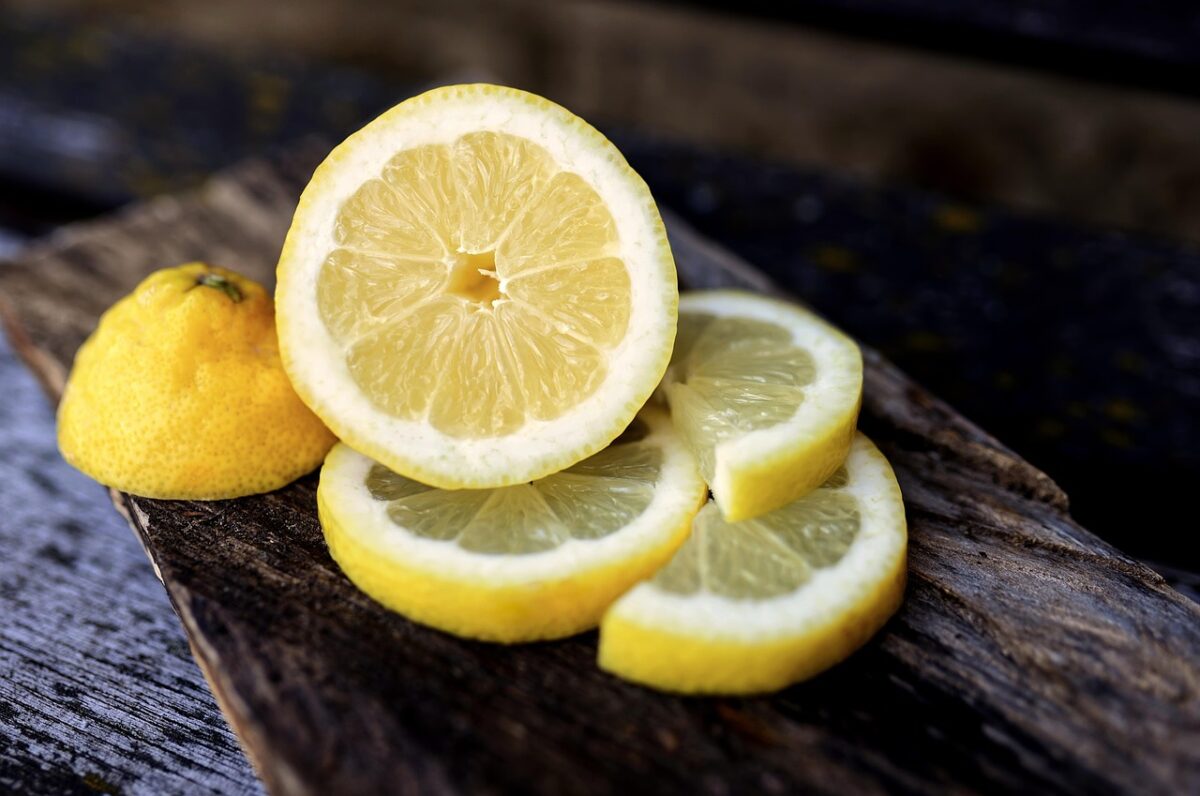
It’s really the juice from the lemon you want. You’ll squeeze the slices for the lemon juice flavor when you get the topping put together. The recipe calls for only two lemon slices, but sometimes I like to slice the entire lemon, so I have extra for guests to squeeze on their bruschetta if they like extra lemon juice.
Crushed Chili Flakes
1 tsp crushed chili flakes
This is optional, and you can leave it out if you or your guests won’t like the slight hint of spice. I think it makes the bruschetta a little more interesting and flavorful.
Vegan Parmesan Cheese
As much vegan Parmesan cheese as you like!
This is also very much optional (and you can use regular Parmesan cheese if you can’t find vegan). What I like to do is find a block or roughly 1-lb wheel of it and then grate it over the bruschetta and anything else I use Parmesan for. You may also find Parmesan labeled as Parmigiano Reggiano.
(When I do use vegan Parmesan, I just use the Follow Your Heart brand.)
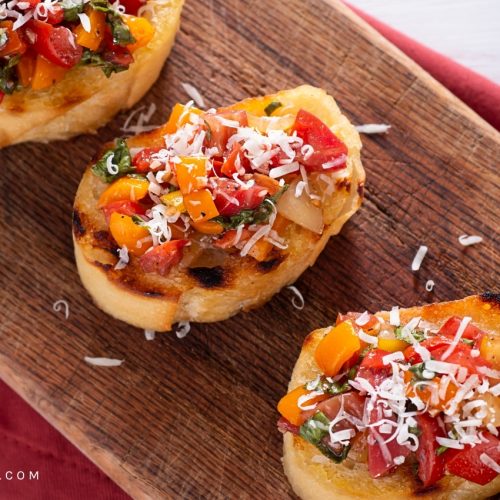
Easy Gluten-Free Bruschetta with Homemade Baguette Printable Recipe Card
Ingredients
For the Baguette
- 3 cups gluten-free flour
- 2 tbsp psyllium husk powder
- 2 tbsp dry yeast
- 1-2 tsp sugar
- 1½ tsp salt
- 1½ cups warm water
- 2 tbsp olive oil
For the Topping
- 4 tbsp olive oil
- 2 cups chopped Roma tomatoes
- ½ cup yellow tomatoes
- ½ cup green or black olives
- 5 cloves garlic
- 1 bunch chopped basil leaves
- 2 slices lemon
- 1 tsp crushed chili flakes optional
- vegan Parmesan cheese can use regular Parmesan cheese
Instructions
Baguette
- Step One: Activate Yeast – Place the yeast and sugar in warm water and stir until the sugar is dissolved. Let it sit for 10-15 minutes until the mixture is foamy.
- Step Two: Mix Dry Ingredients for Bread – While waiting for the yeast to activate, mix together the gluten-free flour mix, psyllium husk powder, and salt in a large bowl until evenly distributed.
- Step Three: Add Yeast Mixture and Olive Oil – Once the yeast is activated, add the yeast mixture and olive oil to the dry ingredients and mix until all the dry ingredients are mixed in. The dough should have the consistency of soft clay, elastic, cohesive, and sticky without being pourable.
- Step Four: Let Dough Rise In Bowl – Tightly cover the top of the bowl with plastic wrap and allow to rise in a warm place for 60-75 minutes until the dough is puffed with a well-defined dome on top.
- Step Five: Form Baguette – Turn the dough onto parchment paper lightly dusted with flour. Using damp hands, gently shape into an elongated baguette. Do not knead.
- Step Six: Let Baguette Rise Cover the baguette with plastic wrap and allow it to rise for 30-40 minutes. While it’s doing its second rise, preheat the oven to 400 degrees Fahrenheit (204 degrees Celsius)
- Step Seven: Bake Baguette – Bake the baguette at 400 degrees Fahrenheit (204 degrees Celsius) for 40-45 minutes until the outside is golden brown and the inside sounds hollow when the loaf is tapped on the bottom.
- Step Eight: Set Aside to Cool – Set the baguette on a cooling rack to cool for about an hour.
- Step Nine: Make Bruschetta Topping – While waiting for the bread to cool, mix olive oil, garlic, balsamic vinegar, basil, salt, and pepper, and optional chili flakes in a medium bowl. Stir in the Roma tomatoes and olives.
- Step Ten: Slice Bread – When the bread is done baking and cooling, slice the bread slightly on the diagonal into ½-inch thick slices.
- Step Eleven: Toast Bread in Skillet – Add olive oil to the skillet, just enough to cover the bottom. Toast bread slices until lightly golden brown on both sides.
- Step Twelve: Serve Crostinis With Tapenade – Arrange the toasted bread slices (crostinis) with the topping mix (tapenade). The tapenade can be either spooned on top of the slices or served on the side for guests to top their crostinis as they like. Serve with vegan parmesan cheese (if desired) and lemon slices for guests to squeeze on top.
Nutrition
Did you make and love this recipe? Give it your review and rating below! And make sure to follow me on Instagram, Pinterest, and Facebook , too!
Instructions for Making Gluten-Free Bruschetta
Got everything? You’ll have to allocate at least 3 hours and 40 minutes for making bruschetta from start to finish. The good part is that you can do other things, like make the topping while waiting for the dough to rise and bake!
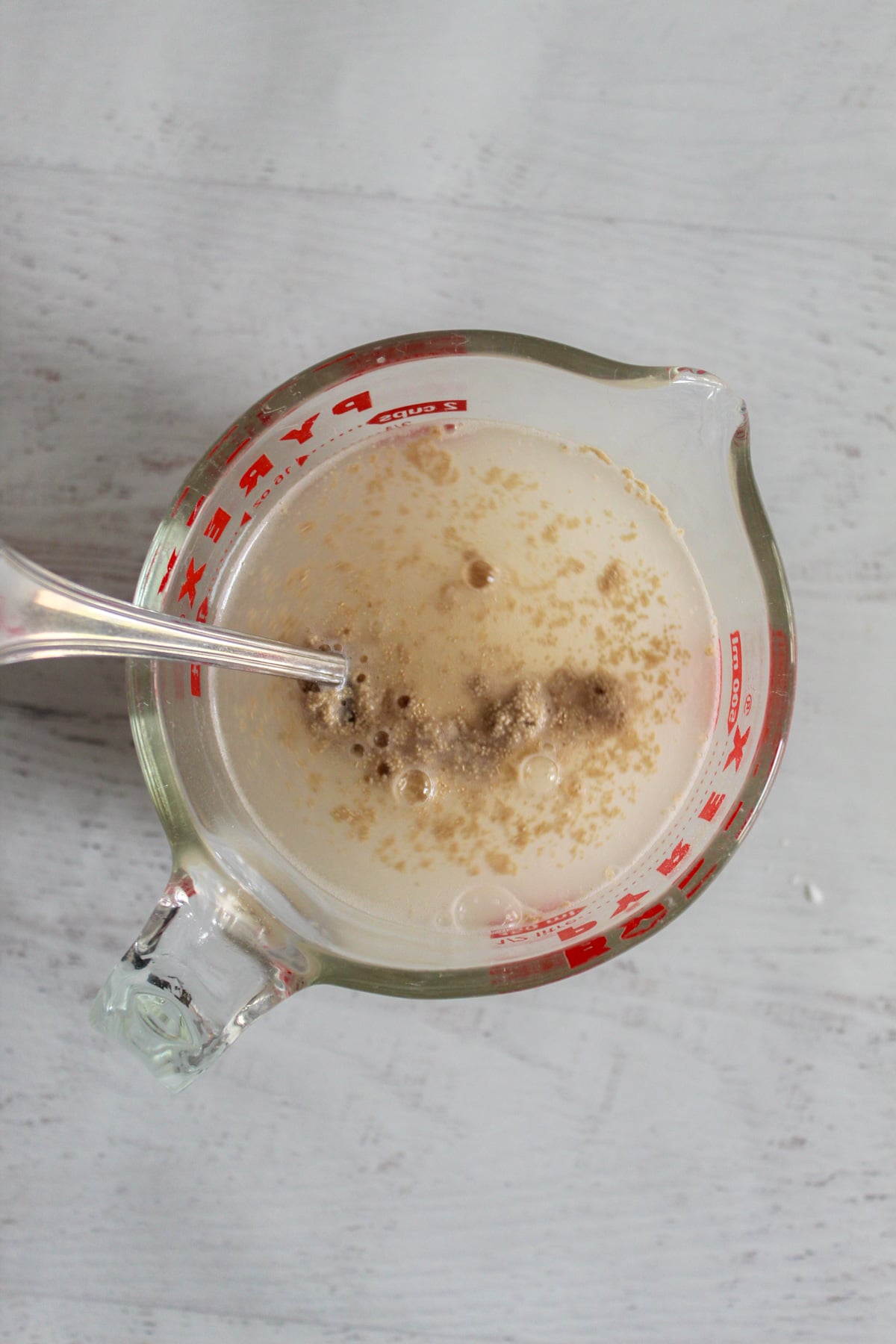
Step One: Activate Yeast
Place yeast and sugar in the warm water and stir until sugar is dissolved. Let it sit for 10-15 minutes until the mixture is foamy. If it doesn’t foam up, the yeast may be inactive (basically, dead) and should be replaced.
Step Two: Mix Dry Ingredients for Bread
While waiting for the yeast to activate, mix together the gluten-free flour mix, psyllium husk powder, and salt in a large bowl until evenly distributed.
Step Three: Add Yeast Mixture and Olive Oil
Once the yeast is activated, add the yeast mixture and olive oil to the dry ingredients and mix until all the dry ingredients are mixed in. The dough should have the consistency of soft clay, elastic, cohesive, and sticky without being pourable.
Step Four: Let Dough Rise In Bowl
This step is called the first rise, where the dough does a lot of the important work of forming its structure. Tightly cover the top of the bowl with plastic wrap and allow to rise in a warm place for 60-75 minutes until the dough is puffed with a well-defined dome on top.
Important: Do not put it in the refrigerator while waiting for it to rise! This is for the same reason you want warm water at the start to activate the yeast. The yeast has to sit at room temperature to do its work of making the dough nice and puffy.
Step Five: Form Baguette
Turn the dough onto parchment paper lightly dusted with flour. Using damp hands, gently shape into an elongated baguette. Do not knead. The loaf should somewhat resemble “French bread” style baguettes, though it doesn’t have to be perfect.
Step Six: Let Baguette Rise
Cover the baguette with plastic wrap and allow it to rise for 30-40 minutes. It won’t double in size, and that’s okay. While it’s doing its second rise, preheat the oven to 400 degrees Fahrenheit (204 degrees Celsius)
Step Seven: Bake Baguette
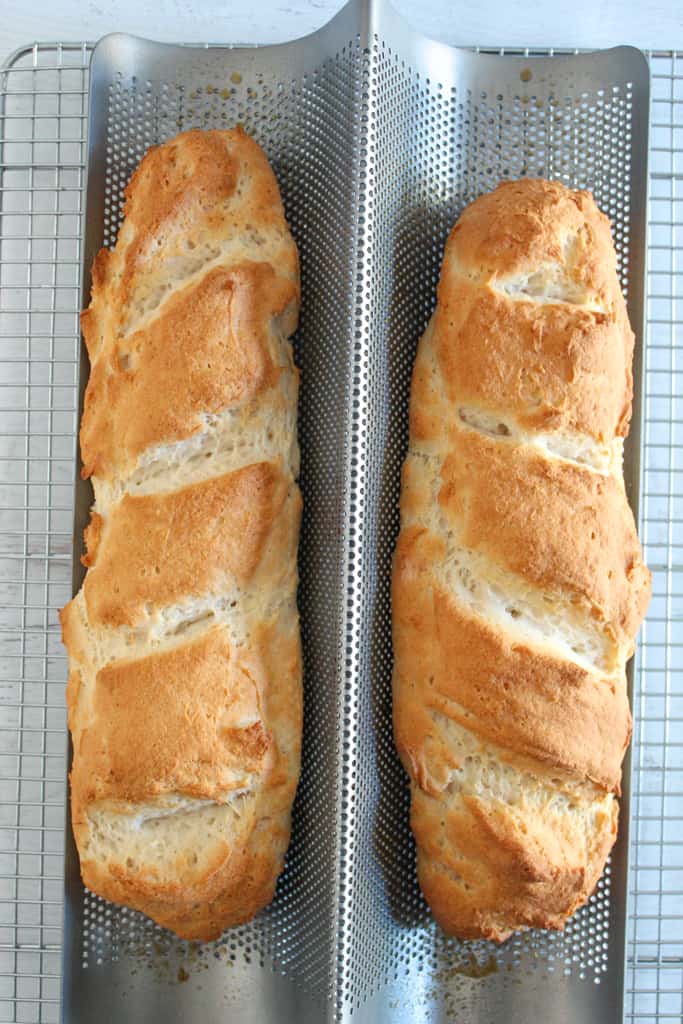
Bake the baguette at 400 degrees Fahrenheit (204 degrees Celsius) for 40-45 minutes until the outside is golden brown and the inside sounds hollow when the loaf is tapped on the bottom. Aim for the shade of brown in the baguettes shown below.
Step Eight: Set Aside to Cool
Set the baguette on a cooling rack to cool for about an hour. Cooling it completely before slicing will give the baguette time to set and prevent it from being too gummy.
Step Nine: Make Bruschetta Topping
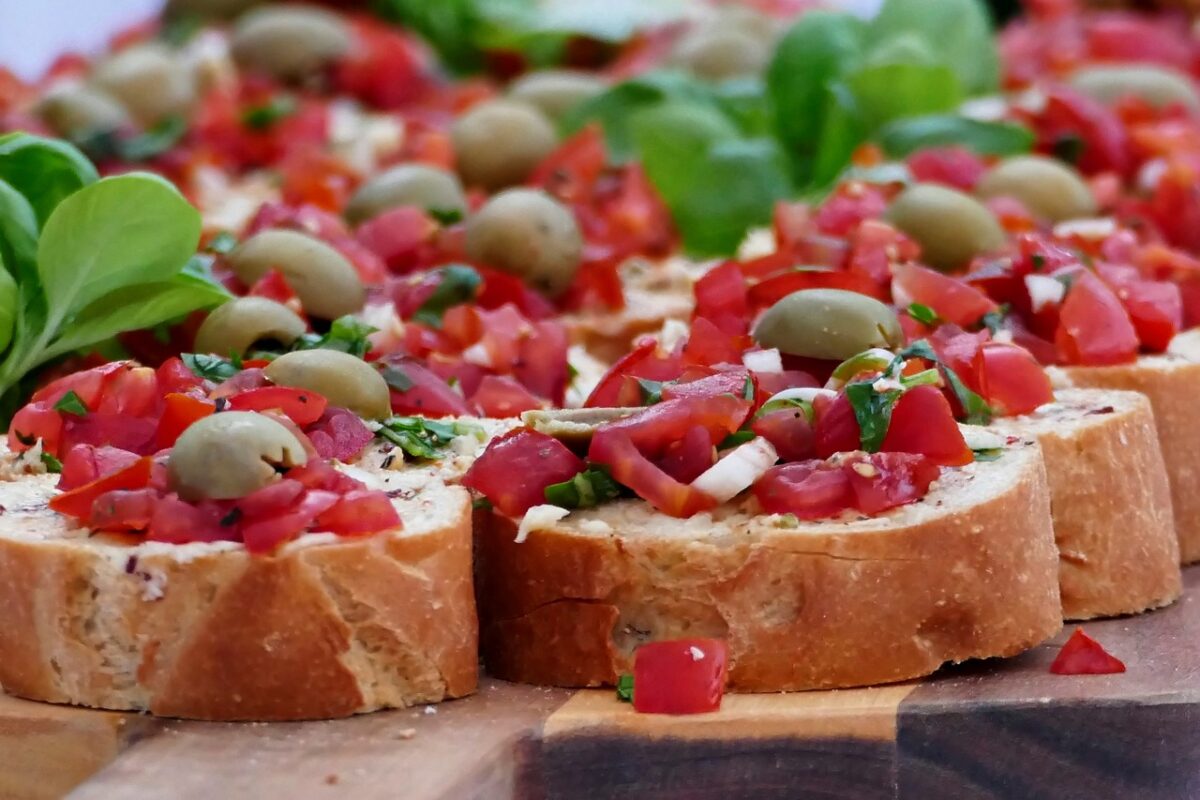
While waiting for the bread to cool, mix olive oil, garlic, balsamic vinegar, basil, salt, and pepper, and optional chili flakes in a medium bowl. Stir in the Roma tomatoes and olives. Refrigerate to chill for 1 hour. This bruschetta topping is called tapenade.
Step Ten: Slice Bread
When the bread is done baking and cooling, slice the bread slightly on the diagonal into ½-inch thick slices.
Step Eleven: Toast Bread in Skillet
Add olive oil to the skillet, just enough to cover the bottom. Toast bread slices until lightly golden brown on both sides. These toasted bread slices are called crostinis.
Step Twelve: Serve Crostinis With Tapenade
Arrange the toasted bread slices (crostinis) with the topping mix (tapenade). The tapenade can be either spooned on top of the slices or served on the side for guests to top their crostinis as they like. Serve with vegan parmesan cheese (if desired) and lemon slices for guests to squeeze on top.
Substitutions for Gluten-Free Bruschetta
If you have trouble finding vegan Parmesan cheese, grating some cheese off a block or wheel of dairy-based Parmesan cheese will work.
You can replace the sugar with 1 to 1 1/2 tablespoons of honey. Adjust amounts of other liquids to suit. But be careful! Yeast can consume honey faster than it consumes sugar. You’ll have to adjust the yeast activation time in the first step of this recipe and the rise times of the bread dough to suit.
FAQs for Gluten-Free Bruschetta
Do you have any questions about this gluten-free bruschetta recipe? We answered the most frequently asked questions below. If you think of one we haven’t thought of yet, please ask in the comments section below, and we’ll try to answer it.
Can I try this bruschetta with sourdough instead?
It’s worth a try if you’d like to try your hand at making some gluten-free sourdough bread!
Why did my baguette come out gummy?
Some common reasons that bread can come out gummy include:
- Too much liquid. It’s easy to add too much water to the yeast mixture, which means too much water in the dough at the end. One easy way to fix this is to gradually add flour until the dough gains the sticky, elastic-like consistency it’s supposed to have.
- Not baked long enough. The bread should be golden brown on the outside. An easy way to tell whether it’s done on the inside is to stick a cooking thermometer into the center of the baguette. It should have an internal temperature of 205 to 210 degrees Fahrenheit.
- Not allowed to cool long enough. Letting it cool at room temperature gives the bread time to finish setting.
- Type of flour used. With flour that contains gluten, you’ll often see ones labeled “all-purpose,” “bread,” or “cake.” This indicates that the flour has an amount of protein that is best suited for the purpose it’s labeled for, and using another type of flour can impact the texture.
With gluten-free flour, you want to use one that’s a mix of tapioca, cornstarch, potato flour, white rice flour, and brown rice flour. I will admit to being a bit of a control freak over this, so I’ll mix up my own gluten-free flour most of the time.
Why did my baguette collapse?
One likely explanation is that too much air got into the dough! This can happen if you used too much yeast or let the dough rise for too long. The baguette can also collapse if an ingredient is measured incorrectly. Too much water, water that was too hot or too cold, too much sugar, or the wrong amount of salt can cause the yeast to go haywire, for instance.
Can I make bruschetta ahead of time?
I like to do exactly that! It can stay fresh in the refrigerator for two to three days, making it one of my favorite appetizers to make ahead of time for entertaining purposes.
Can I serve it with wine?
It pairs well with a nice Pinot Grigio, Sauvignon Blanc, or Rosé Wine. If you prefer red wine, aim for a light-bodied one like Chianti or Pinot Noir.
Other Recipes to Try for Your Appetizer Spread
If you’re putting together a fun appetizer board or planning a cozy gathering, bruschetta is just the beginning. Add a few more homemade gluten-free breads, and you’ve got the perfect spread for dipping, sharing, and snacking.
- Soft Gluten-Free Breadsticks (Ready in 45 Minutes) – Warm, fluffy breadsticks that are perfect for dipping in olive oil, marinara, or your favorite spreads.
- Best Gluten-Free Dairy-Free Dinner Rolls – Light and fluffy rolls that make a great addition to any appetizer or snack table.
- Quick Gluten-Free Pita Bread Recipe – Soft, versatile pita that’s perfect for scooping dips, spreads, or extra bruschetta topping.
- Golden Gluten-Free French Bread (Dairy-Free) – A bakery-style loaf that’s perfect for slicing into crostini or serving with olive oil and herbs.
Mix and match a few of these breads with your bruschetta, and you’ll have an appetizer spread that’s perfect for sharing, whether it’s a casual get-together, a holiday snack table, or just a fun
Is Gluten-Free Bruschetta Your New Favorite Appetizer?
This Gluten-Free-Bruschetta with Fresh Tapenade is the answer to boring apps and store-bought spreads. It’s crisp, it’s punchy, and it proves you don’t need gluten to make something that tastes gourmet. Whether you’re serving this at your next get-together or piling it high for a solo snack dinner, one thing’s guaranteed: you’ll want to make a double batch.
Have you tried this gluten-free bruschetta? Let us know how it turned out and what toppings you used in the comments. We’d love to hear your favorite variations!